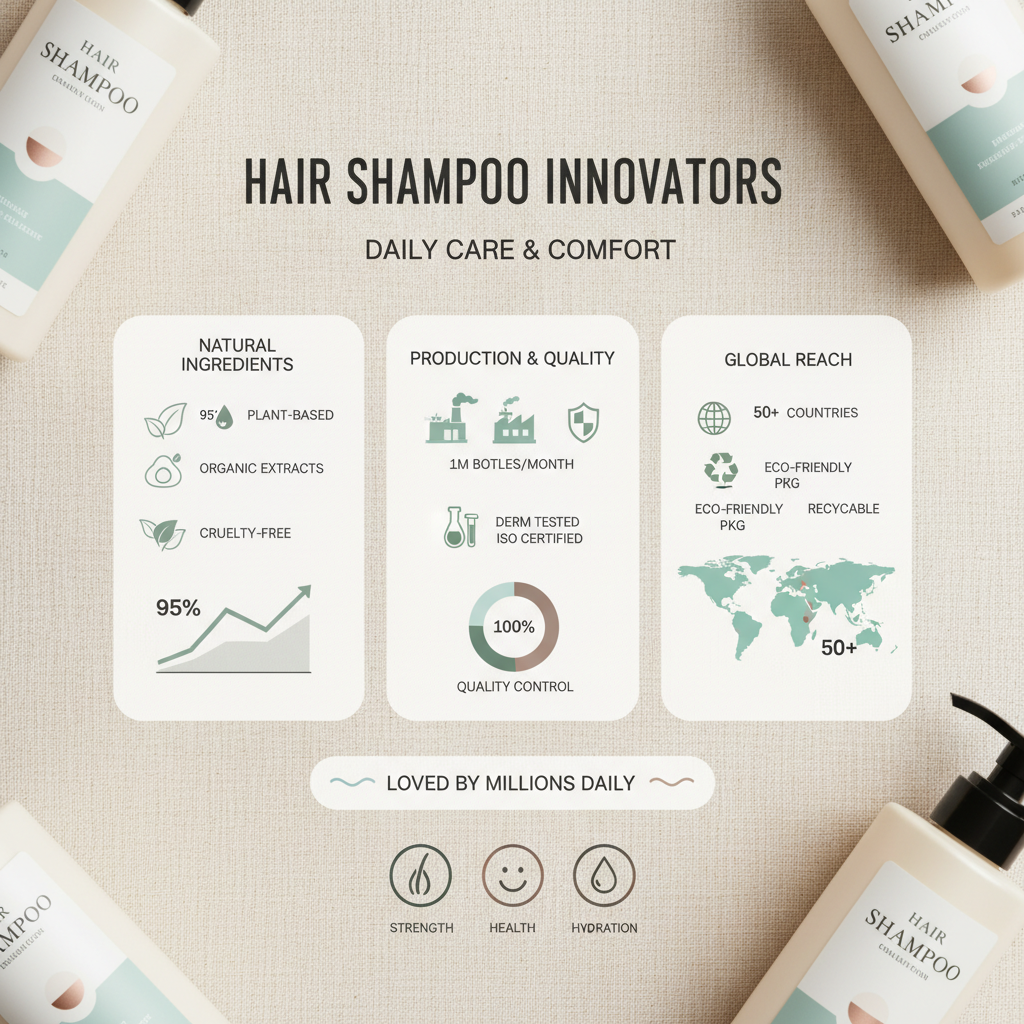
Finding a reliable Hair Shampoo Manufacturer is a critical strategic decision for beauty brands aiming to balance clinical efficacy with commercial scalability. In an era where consumers demand transparency in ingredients and sustainable sourcing, the role of the manufacturer extends beyond simple mixing to comprehensive research, development, and regulatory compliance.
The global personal care market has witnessed a seismic shift toward "clean beauty" and specialized scalp health, placing immense pressure on the supply chain to innovate. A professional Hair Shampoo Manufacturer must now integrate advanced dermatology with green chemistry to create formulas that are not only effective but also environmentally responsible.
Understanding the technical capabilities of your production partner—from sulfate-free surfactant systems to micronized nutrient delivery—can be the difference between a product that lingers on the shelf and one that dominates the market. By aligning with a manufacturer that prioritizes E-E-A-T (Experience, Expertise, Authoritativeness, and Trustworthiness), brands can ensure long-term consumer loyalty and safety.
The Role of a Professional Hair Shampoo Manufacturer in Modern Beauty
A dedicated Hair Shampoo Manufacturer acts as the bridge between a conceptual brand vision and a tangible, market-ready product. This partnership involves more than just assembly; it encompasses the critical phase of stability testing, where the manufacturer ensures that the product remains effective and safe across various temperatures and timeframes.
By leveraging industrial-scale equipment and laboratory expertise, a professional manufacturer can refine a "kitchen-made" prototype into a sophisticated commercial formula. This transformation ensures consistency in viscosity, pH balance, and fragrance retention, which are the hallmarks of a premium consumer experience.
Key Quality Indicators for Shampoo Production
When evaluating a Hair Shampoo Manufacturer, the first priority is the precision of the surfactant system. The balance between primary cleansers (like Sodium Laureth Sulfate or gentle alternatives like Coco-Glucoside) and secondary conditioners determines whether the shampoo leaves the hair feeling stripped or silky.
Beyond the chemistry, the manufacturing environment must adhere to strict Good Manufacturing Practices (GMP). This includes the use of medical-grade stainless steel mixing tanks and closed-loop filtration systems that prevent microbial contamination, ensuring that every batch meets ISO safety standards.
Finally, the capability for "customization at scale" is a vital indicator. A top-tier manufacturer can seamlessly pivot between producing a clarifying shampoo for oily scalps and a deep-conditioning formula for damaged hair without compromising the purity of the production line.
Formulation Science and Ingredient Integration
The sophistication of a Hair Shampoo Manufacturer is most evident in its ability to integrate active ingredients without destabilizing the emulsion. For instance, adding botanical oils or proteins requires precise emulsification techniques to prevent separation over time.
Advanced Hair Shampoo Manufacturer facilities now utilize cold-process blending to preserve the bioactivity of heat-sensitive vitamins and organic extracts, ensuring that the "natural" claims on the label are backed by actual chemical potency.
Furthermore, the integration of pH buffers is essential. A manufacturer must ensure the final product aligns with the natural pH of the human scalp (typically between 4.5 and 5.5) to prevent cuticle inflammation and maintain hair luster.
Scalability and Manufacturing Efficiency
For growing brands, the ability of a Hair Shampoo Manufacturer to scale production from small trial batches to multi-ton shipments is indispensable. This requires a modular approach to production, where automated filling lines can be adjusted for different bottle sizes and packaging types.
Efficiency is not just about speed, but about reducing waste through lean manufacturing. By optimizing the raw material procurement process and utilizing high-efficiency homogenizers, a manufacturer can lower the cost per unit while maintaining a premium quality profile.
Comparative Efficiency of Hair Shampoo Manufacturer Production Methods
Global Regulatory Compliance and Safety Standards
Navigating the complex web of international cosmetics regulations is perhaps the most daunting task for any brand. A sophisticated Hair Shampoo Manufacturer provides essential guidance on FDA (USA), EU Cosmetics Regulation, and NMPA (China) requirements, ensuring that ingredients are permitted and labeled correctly.
Safety assessments, including dermatological patch testing and preservative efficacy testing (PET), are mandatory steps in the manufacturing pipeline. By conducting these in-house or through certified third-party labs, the manufacturer mitigates the risk of product recalls and protects the brand's reputation.
Sustainable Sourcing and Green Chemistry
The modern Hair Shampoo Manufacturer is increasingly defined by its commitment to sustainability. This includes shifting away from petroleum-based surfactants toward plant-derived alternatives like decyl glucoside and utilizing biodegradable chelating agents.
Water conservation is another critical focal point. Advanced manufacturers are implementing water-recycling systems within their plants to reduce the environmental footprint of the rinsing and cleaning phases of production.
Beyond the formula, the choice of packaging—such as PCR (Post-Consumer Recycled) plastics or compostable materials—is now integrated into the manufacturing workflow, allowing brands to offer a truly circular product lifecycle.
Future Innovations in Hair Care Manufacturing
The future of the Hair Shampoo Manufacturer landscape lies in personalization. We are seeing a move toward "micro-batching" and AI-driven formulation, where shampoo can be tailored to an individual's specific scalp microbiome and hair porosity.
Another emerging trend is the transition to waterless formulations, such as shampoo bars and concentrated powders. This requires a total overhaul of traditional liquid-mixing equipment, pushing manufacturers to adopt extrusion and compression technologies.
Digital transformation, including IoT-enabled quality monitoring and blockchain for ingredient traceability, will soon become the industry standard, providing consumers with an unprecedented level of transparency from the farm to the shower.
Comparative Analysis of Next-Gen Manufacturing Trends
| Innovation Type |
Technical Shift |
Market Impact |
Implementation Score |
| AI Customization |
Algorithmic Formulation |
High Hyper-Personalization |
7/10 |
| Waterless Tech |
Extrusion/Powder Press |
Eco-conscious Growth |
9/10 |
| Microbiome Focus |
Prebiotic Integration |
Medical-grade Care |
8/10 |
| Circular Packaging |
PCR Polymer Molding |
Zero-Waste Appeal |
10/10 |
| Cold-Process Blending |
Low-Heat Agitation |
Nutrient Preservation |
8/10 |
| Blockchain Tracking |
Digital Ledger Integration |
Extreme Transparency |
6/10 |
FAQS
Look for a manufacturer that offers flexible Minimum Order Quantities (MOQs) and has a proven track record in your specific niche, such as sulfate-free or organic care. Ensure they possess the necessary certifications (ISO, GMP) and provide comprehensive stability testing and regulatory support to ensure your product is safe for global distribution.
Yes, most full-service manufacturers provide R&D teams that can develop bespoke formulas based on your desired active ingredients and target results. This process usually involves several iterations of sampling and testing to perfect the scent, texture, and performance before moving to full-scale production.
Lead times vary based on the complexity of the formula and packaging. Generally, formulation and sampling take 4-8 weeks, while the actual production and filling process can take another 4-6 weeks. It is essential to account for regulatory approval times if you are exporting to strictly regulated markets.
Sulfate-free formulas are technically more challenging because they often lack the natural foaming and thickening properties of sulfates. A skilled manufacturer uses advanced blends of glucosides and betaines, along with specific viscosity modifiers, to ensure the product still feels luxurious and cleanses effectively without the harsh chemicals.
Stability is managed through the use of natural antioxidants, precise pH control, and broad-spectrum preservative systems. Professional manufacturers also conduct "accelerated aging tests," exposing the product to high heat and humidity to simulate months of shelf life in a matter of weeks.
Most manufacturers allow you to provide your own packaging, but they will first perform "compatibility testing" to ensure the shampoo formula doesn't react with the plastic or glass material. Alternatively, many manufacturers offer a catalog of pre-approved, sustainable packaging options to streamline the process.
Conclusion
Selecting a premier Hair Shampoo Manufacturer is a cornerstone of brand success in the competitive beauty landscape. From the intricate chemistry of surfactant systems to the rigorous demands of global regulatory compliance, the right partner ensures that your product is not only commercially viable but also scientifically sound and safe for the end consumer.
As the industry pivots toward sustainability, personalization, and waterless technologies, the synergy between brand vision and manufacturing expertise will become even more vital. We encourage brands to prioritize partners who embrace green chemistry and transparent sourcing to build a future-proof beauty line. Visit our website for more information: www.yunmeicosmetic.com